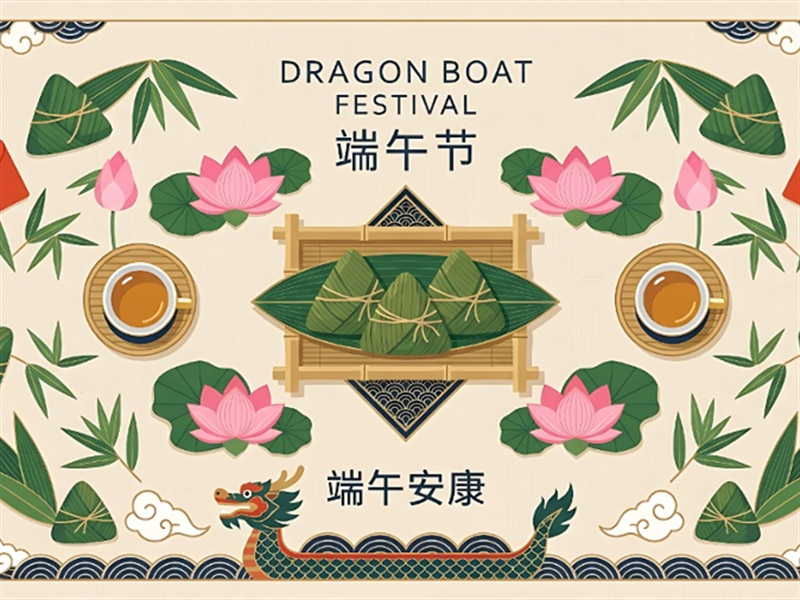










The Ancient Traditions Behind the Dragon Boat Festival China has three major traditional festivals. Do you know which three they are? They are the Duanwu Festival (Dragon Boat Festival), Chinese New Year, and the Mid-Autumn Festival. Let’s talk about the Duanwu Festival. You may wonder: what does “Duanwu” mean? The term may sound difficult to understand. In ancient Chinese, “duan” (端) means “beginning” or “opening,” while “wu” (午) has a special meaning. You might think the “wu” in Duanwu refers to the character for “noon.” In fact, it does. Ancient China used the Twelve Earthly Branches (子、丑、寅、卯、辰、巳、午、未、申、酉、戌、亥) to represent time. For example: 11 p.m.–1 a.m. = Zi hour (子时) 1 a.m.–3 a.m. = Chou hour (丑时) Following this system, 11 a.m.–1 p.m. is the Wu hour (午时). Before 11 a.m. we say “morning” (上午), and after 1 p.m. we say “afternoon” (下午). The Twelve Earthly Branches were also used to represent months in the traditional lunar calendar. The fifth lunar month corresponds to the branch “Wu” (午). Since the Dragon Boat Festival falls on the fifth day of the fifth lunar month, the name “Duanwu” is connected to this “Wu” month and “Wu” hour. Now you know where the name comes from. Health and protection during the fifth lunar month In ancient times, the fifth lunar month was also called the “Poison Month” or “Evil Month.” A traditional saying goes: “During the Dragon Boat Festival, the weather turns hot, and the ‘five poisons’ awaken.” The “five poisons” traditionally refer to creatures such as snakes, scorpions, centipedes, lizards, and toads. Because of this belief, one of the most important themes of the Dragon Boat Festival was warding off illness, harmful influences, and misfortune while maintaining health and safety. Even today, people often say “Duanwu Ankang” (Peace and Good Health on the Dragon Boat Festival) rather than simply “Happy Dragon Boat Festival.” Tradition 1: Hanging mugwort and calamus Before sunrise on the festival day, people would gather mugwort (艾草) and hang it above their doors. Families also hung calamus (菖蒲) on doorways, windows, and eaves. People believed the strong fragrance of these plants could drive away disease and negative influences. According to traditional Chinese medicine, mugwort is considered a warming herb that helps dispel dampness and support the body’s energy. Traditional Chinese medicine also teaches: “When righteous energy exists within, harmful influences cannot invade.” In other words, maintaining strong positive energy and good health helps protect a person from illness and adversity. Tradition 2: Drinking realgar wine Mentioning realgar wine (雄黄酒) may remind people of the famous legend of the White Snake. In the story, a monk tells Xu Xian that his wife Bai Suzhen is actually a thousand-year-old snake spirit. To reveal her true form, he persuades Xu Xian to give her realgar wine during the Dragon Boat Festival. After drinking it, she transforms back into a giant white snake, terrifying Xu Xian. Historica...
بیشتر ببینید